Reading Curriculum Intent Implementation and Impact Statement
Intent
At Hannah More Primary School, our intent is to develop confident, fluent and enthusiastic readers who value reading as a lifelong skill for learning, enjoyment and personal growth. We recognise and celebrate the richness of our diverse community, ensuring that it is well represented within our reading curriculum so that every child sees themselves reflected in the texts they encounter. We believe that reading is central to all learning and provides the foundation for success across the curriculum.
Our curriculum is designed to:
- Build strong phonics knowledge so that every child can decode words accurately and quickly.
- Develop fluency and stamina, enabling children to read with understanding, expression and confidence.
- Broaden vocabulary and language skills through high-quality texts that reflect diverse themes, cultures and experiences.
- Promote comprehension by teaching children to think critically, make connections, infer meaning and discuss what they read.
- Foster a love of reading, encouraging children to enjoy books, discover new authors and engage with a wide range of text types.
- Ensure equity and inclusion, offering high-quality support and challenge so that all pupils—including PP, EAL and SEND learners—can access, enjoy and succeed in reading.
- Support new arrivals by assessing their individual starting points and providing targeted teaching so they quickly gain the skills needed to catch up with their peers and participate fully in learning.
Through a structured, progressive and engaging reading curriculum, we aim to ensure every child leaves our school as a capable, motivated and independent reader who is well-prepared for the next stage of their education.
Implementation
Systematic Phonics Instruction
In Early Years and Key Stage 1, we follow the ‘Little Wandle Letters and Sounds’ revised programme to ensure high-quality, systematic and synthetic phonics teaching. Phonics lessons are taught daily, following the programme with consistency so that pupils build secure knowledge of grapheme–phoneme correspondences, blending, segmenting and common exception words.
- Regular assessment identifies pupils who need additional practice groups or targeted intervention, ensuring rapid progress.
- Our systematic approach ensures that children are well prepared for, and supported to pass, the Year 1 Phonics Screening Check.
- For pupils in Key Stage 2 who have gaps in their decoding skills, ‘Little Wandle Rapid Catch-Up’ provides a structured intervention pathway, enabling them to catch up quickly with their peers.
Core Text Approach
Throughout Key Stages 1 and 2, we use a high-quality core text approach to drive both reading and writing. Carefully selected texts reflect a wide range of authors, cultures, genres and themes, and are purposefully chosen to link to each term’s enquiry question, helping children deepen their understanding across the curriculum. See our Writing Curriculum for further details on our core texts.
- Core texts are used to teach explicit reading strategies, broaden vocabulary and model rich language.
- Reading and writing are closely linked: children analyse texts deeply, explore structure and language features, and apply these in their own writing.
- Teachers model fluent reading, guide discussion and use questioning to develop comprehension, inference and critical thinking.
Developing Fluency & Comprehension
In EYFS and Key Stage 1, we run ‘Cosy Club’, a structured small-group reading programme designed by Little Wandle to give every child regular, focused practice with reading.
- Children read in a small group with an adult at least three times a week, using fully decodable books carefully matched to their phonics stage, applying the phonics they have secured.
- Each text is read three times to build fluency and confidence:
- Decoding – children practise recognising graphemes and blending to read words accurately.
- Prosody – children focus on reading with expression, phrasing, and appropriate pace.
- Comprehension – children discuss and answer questions about the text to ensure understanding.
- These books are then sent home to reinforce learning.
To further strengthen fluency and comprehension in Key Stage 2, we implement the structured ‘Ready Steady Read Together’ programme. This sequenced, whole-class reading programme provides clear routines and explicit teaching of comprehension and fluency strategies. Ready Steady Read Together complements our core text approach and ensures progression across Key Stage 2, enabling pupils to discuss texts confidently and respond to increasingly complex vocabulary and ideas.
- Each term, children read a high-quality fiction, non-fiction, and poetry text, providing a broad range of reading experiences
- Pupils follow a structured cycle of shared reading, partner reading, repeated reading, and oral rehearsal to build accuracy, pace, expression, and confidence.
- Lessons focus on comprehension strategies including summarising, predicting, retrieving, inferring, and evaluating, and teach new vocabulary and language patterns.
- The programme uses high-quality, diverse texts and links progression across the school year, ensuring all pupils develop deeper understanding and higher-level reading skills.
KS2 Reading lessons follow a two-week cycle, providing consistency and structured progression.
- Pupils receive four 45-minute reading lessons per week, focusing on comprehension, vocabulary, fluency, and linked enquiry content.
- The five ‘Ready Steady Read Together’ lessons are spread across the two-week cycle to ensure coverage of all key reading skills.
- Within the two-week cycle, there is a stand-alone lesson specifically designed to address gaps, misconceptions, or additional practice needs identified in previous lessons.
- Each week also includes a Reading for Pleasure slot, giving pupils time to engage with books of personal choice, explore authors and genres, share their preferences with the class and develop a love of reading.
This cycle ensures that pupils receive structured, high-quality teaching while allowing time for targeted support and fostering reading enjoyment.
Reading for Pleasure
At Hannah More, reading is at the centre of all we do. We aim for every pupil to understand the value of reading, both as a key life skill and as a source of enjoyment, curiosity, and to support their academic learning.
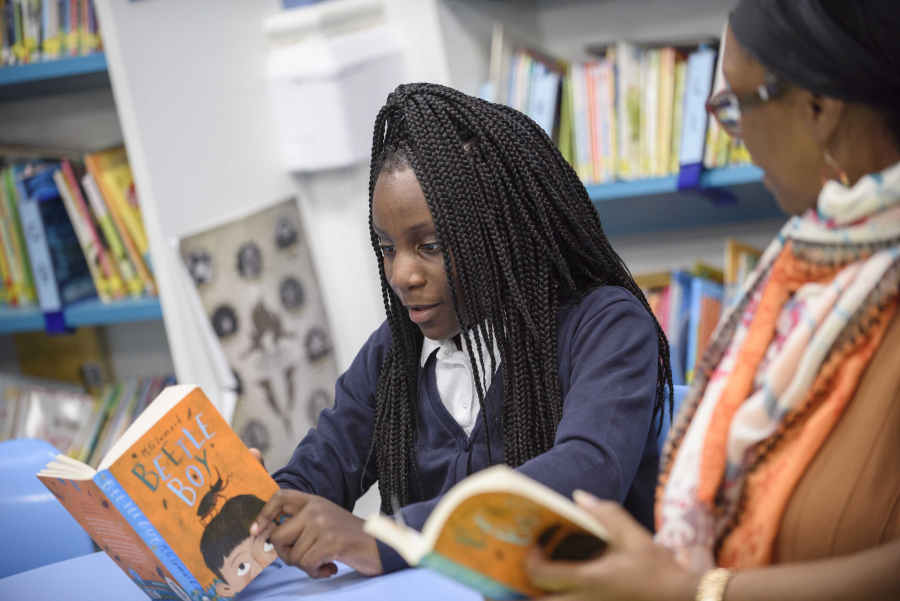
- Pupils have regular opportunities to explore high-quality texts across the curriculum and during daily story time and ERIC (everyone reading in class), developing a love of reading that extends beyond the classroom.
- Every week, classes visit ‘The Hub’, our school library, where children can browse, select, and borrow books.
- Children are encouraged to take books home to share with their families, fostering a culture of reading at home and strengthening home–school connections.
Impact
The effectiveness of our reading curriculum is carefully monitored through a robust assessment framework that ensures all students make consistent progress. Benchmarking, regular fluency checks, phonics assessments, and both formative and summative evaluations provide ongoing insight into each child’s reading attainment. NFER reading tests, conducted three times a year in Year 2 – 6, allow for systematic tracking of progress and identification of areas for targeted support.
The reading leader conducts regular learning walks, book scrutinies, pupil voice consultations, and environment checks, providing tailored support and challenge to teaching staff where needed. In addition, structured coaching and carefully mapped out professional development help teachers refine their instructional practices, ensuring high-quality teaching is consistently seen across the school.
Together, these measures ensure that the reading curriculum fulfils its intent to provide a rich, structured, and engaging reading experience, enabling all children to develop strong foundational reading skills, achieve academic success, and cultivate a lifelong love of reading.